
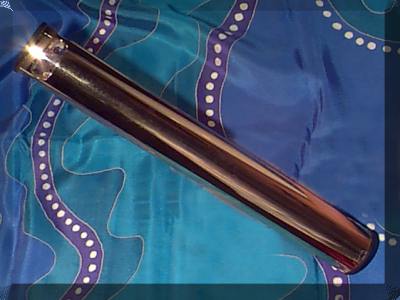
 Carefully placed
kaleidoscope
close to her eye
slowly turning
viewing colored,
broken shards
glass that forms
patterns
that she tries to
capture
each one a distant
meaning
in her memory
Beginning to turn
ever faster
cylinder
grasped gently
pieces of
rainbow colors
hinged
collide to try
connecting
bringing emotions
joyous sapphire
touching
crimson anger
The world fades
disconnected
pulling her along
whirlwind confusion
tied to wonderment
jagged edges
glass threatening
images retract
imploding
telescoping then
she’s gone
kaleidoscope
remaining
© November 2011 Renee Espriu
Thought I would give you some information on the history of the kaleidoscope, which I absolutely love and have a few of them, myself. Hope you enjoy!
Kaleidoscope
A kaleidoscope is a circle of mirrors containing loose, colored objects such as beads or pebbles and bits of glass. As the viewer looks into one end, light entering the other end creates a colorful pattern, due to the reflection off the mirrors. Coined in 1817 by Scottish inventor Sir David Brewster,[1] the word “kaleidoscope” is derived from the Ancient Greek καλ(ός) (beauty, beautiful), είδο(ς) (form, shape) and -σκόπιο (tool for examination)—hence “observer of beautiful forms.” [2]
Design
Kaleidoscopes operate on the principle of multiple reflection, where several mirrors are attached together. Typically there are three rectangular lengthwise mirrors. Setting the mirrors at a 45-degree angle creates eight duplicate images of the objects, six at 60°, and two at 90°. As the tube is rotated, the tumbling of the coloured objects presents the viewer with varying colours and patterns. Any arbitrary pattern of objects shows up as a beautiful symmetrical pattern created by the reflections in the mirrors. A two-mirror model yields a pattern or patterns isolated against a solid black background, while a three-mirror (closed triangle) model yields a pattern that fills the entire field.
For a 2D-symmetry group, a kaleidoscopic point is a point of intersection of two or more lines of reflection symmetry. In a discrete group, the angle between consecutive lines is 180°/n for an integer n≥2. At this point there are n lines of reflection symmetry, and the point is a center of n-fold rotational symmetry. See also symmetry combinations.
Modern kaleidoscopes are made with brass tubes, stained glass, wood, steel, gourds and almost any other material an artist can sculpt or manipulate. The part of the kaleidoscope containing objects to be viewed is the ‘object chamber’ or ‘object cell’. Object cells may contain almost any material. Sometimes the object cell is filled with liquid so the items float and move through the object cell with slight movement from the person viewing.
History
Patterns as seen through a kaleidoscope tube
Sir David Brewster began work leading towards invention of the kaleidoscope in 1815 when he was conducting experiments on light polarization[1] but it was not patented until two years later.[3] His initial design was a tube with pairs of mirrors at one end, pairs of translucent disks at the other, and beads between the two. Brewster chose renowned achromatic lens developer Philip Carpenter as the sole manufacturer of the kaleidoscope in 1817. It proved to be a massive success with two hundred thousand kaleidoscopes sold in London and Paris in just three months. Realising that the company could not meet this level of demand Brewster requested permission from Carpenter on 17 May 1818 for the device to be made by other manufacturers, to which he agreed.[4] Initially intended as a science tool, the kaleidoscope was later copied as a toy. Brewster later believed he would make money from this popular invention; however, a fault in his patent application allowed others to copy his invention.[1]
Cozy Baker (d. October 19, 2010)—founder of The Brewster Kaleidoscope Society—collected kaleidoscopes and wrote books about a few of the artists making them in the 1970s through 2000. Baker is credited with energizing a renaissance in kaleidoscope-making in America. In 1999 a short-lived magazine dedicated to kaleidoscopes—Kaleidoscope Review—was published, covering artists, collectors, dealers, events, and including how-to articles. This magazine was created and edited by Brett Bensley, at that time a well-known kaleidoscope artist and resource on kaleidoscope information.
Craft galleries often carry a few kaleidoscopes, while other enterprises specialize in them, carrying dozens of different types from different artists and craftspeople.


i dont know about her but the way you play with colours, words and other beautiful things is amazing. i wish i could create half of your magic in my poems.
just adored it.
LikeLike
Thanks Trisha! I guess I love imagination, fantasy, magic as a setting for telling a story so I get carried away. When I was a child going to another land or another different world so appealed to me, like in The Wizard of Oz or Alice in Wonderland. Glad you liked my post.
LikeLike
Oh, I’ve loved Kaleidoscopes ever since I was a young kid. They we always so magical to me and just a tiny movement would bring entirely new shapes and colour mixes to be fascinated by all over again.
This was so full of great facts and information. A lovely, absorbing, memory provoking, read.
LikeLike
Thanks Bren! To become lost in it all like becoming lost in my words is a
wonderful thing.
LikeLike
I remember having a kaleidoscope as a child and being completely mesmerized by it. I would love to have another one some day and lose myself in the mandala-like patterns that show up. I’ve looked them up on the internet at times and some can be quite costly.
Thanks for an enchanting poem and wonderful information on this incredible invention.
LikeLike
Yes, some of them are quite costly. I have only a couple myself, both made of wood and wonderous to look inside of. I hope to obtain another at some point. Thanks for enjoying the poem and afterward.
LikeLike
kaleidoscopes are magical.. the breaking and getting whole again…arranged in new ways…enjoyed your beautiful poem and also the background..
LikeLike
Thank You Claudia! They are things of wonder and to see images that are never the same way twice…well, that is amazing.
LikeLike
It is nice to know that by your depiction when things fall apart they come back together again. In this, we seem to trust the powers that be and the process of life moving full circle. Yes, things have a way of coming around again, and the second time around, we hope for better, much clearer results.–Candy
LikeLike
Beautiful words Renee… this brought back memories of when I was a child as I had a Kaleidoscope and loved it… I was very interested in reading its origins. a very imformative post and beautiful poem Renee.. xx
LikeLike
Glad you liked the background of it and have to say I learned some things myself. Thank You Sue!
LikeLike
It amazing isnt it… We learn every day 🙂 something new, thats why I just so love Life 🙂
LikeLike
I, too, am a kaleidoscope freak. Had one when I was young that was mostly pearly pastels. You’d think the more colorful the better – but there was a majesty about this one… wish I still had it. I felt like I owned precious gems when I held it. As always, love your history included. Thanks so much for a treat – a short trip back in time. Take care, Amy
http://sharplittlepencil.wordpress.com/2011/11/17/the-high-church-of-jazz-poets-united/
LikeLike
I like that so many people like the kaleidoscope. Thank you for visiting and glad you liked the post and background to go with.
LikeLike
Renee, this is just lovely. You brought back some very fond childhood memories for me with this piece. Thank you. I love the history you’ve included here.
Pamela
LikeLike
Thank you Pamela and am happy that you found some good things to remember with reading the post.
LikeLike
Happy Thanksgiving Renee, enjoy your day!
Pamela
LikeLike
Delightful verse and history. I also love crystals. I have several haning to briefly catch the suns’ rays. It is fun to watch my grandchild try to ‘catch’ the rainbows on the wall and floor. We also spin the ‘sparkleeze’ to catch the multifaceted views of color.
LikeLike
Thanks Jules! Seems more people than not love the things that prisms do with light and colors. Aren’t the little ones the best, though.
LikeLike
Joyous and sad like life’s journey – takes me straight back to my childhood 🙂
LikeLike