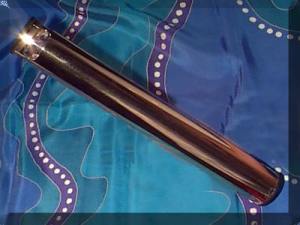
 Carefully placed
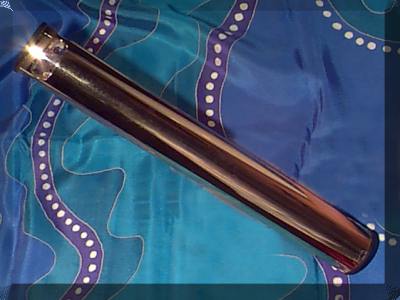
kaleidoscope
close to her eye
slowly turning
viewing colored,
broken shards
glass that forms
patterns
that she tries to
capture
each one a distant
meaning
in her memory
Beginning to turn
ever faster
cylinder
grasped gently
pieces of
rainbow colors
hinged
collide to try
connecting
bringing emotions
joyous sapphire
touching
crimson anger
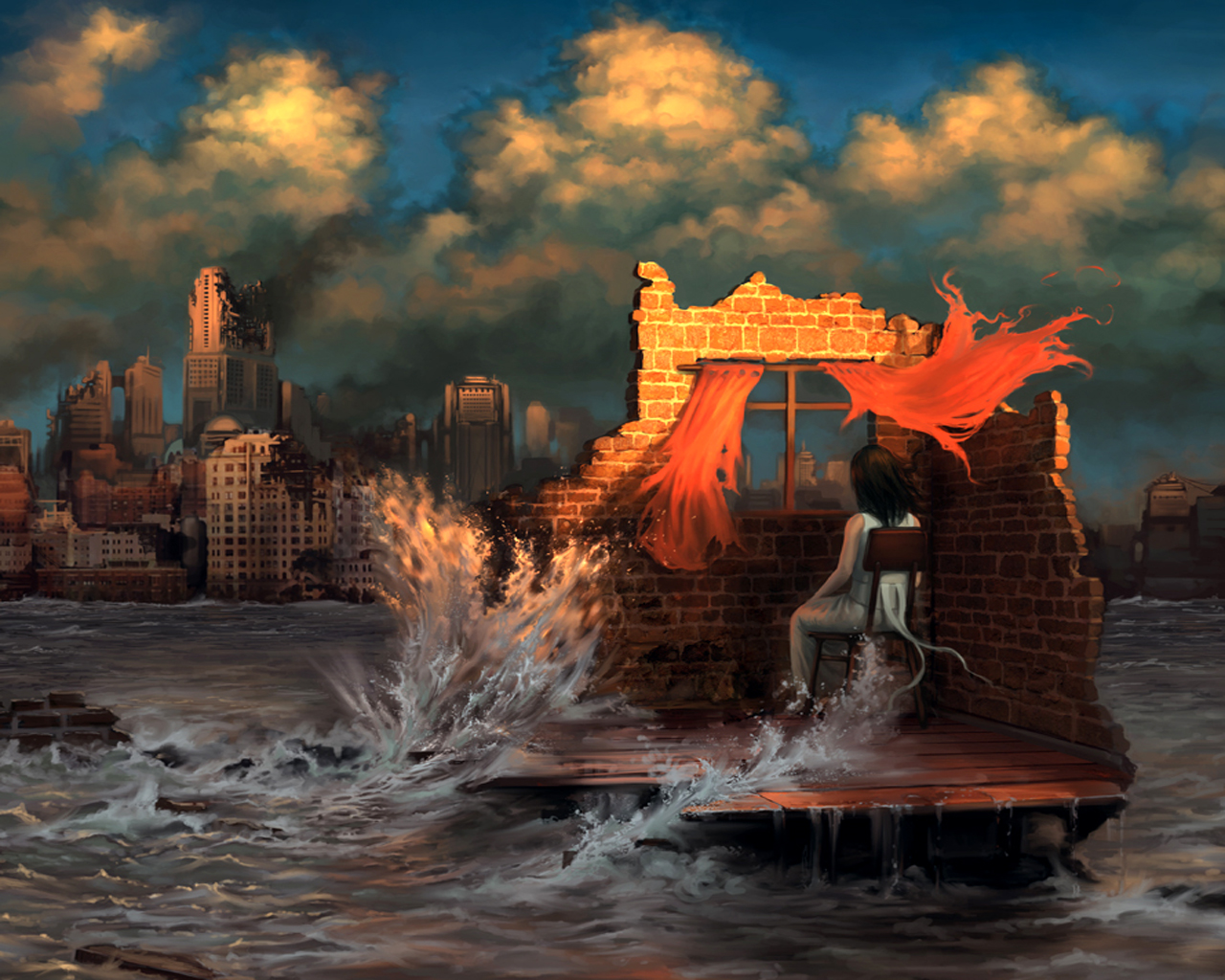
The world fades
disconnected
pulling her along
whirlwind confusion
tied to wonderment
jagged edges
glass threatening
images retract
imploding
telescoping then
she’s gone
kaleidoscope
remaining
© November 2011 Renee Espriu
Thought I would give you some information on the history of the kaleidoscope, which I absolutely love and have a few of them, myself. Hope you enjoy!
Kaleidoscope
A kaleidoscope is a circle of mirrors containing loose, colored objects such as beads or pebbles and bits of glass. As the viewer looks into one end, light entering the other end creates a colorful pattern, due to the reflection off the mirrors. Coined in 1817 by Scottish inventor Sir David Brewster,[1] the word “kaleidoscope” is derived from the Ancient Greek καλ(ός) (beauty, beautiful), είδο(ς) (form, shape) and -σκόπιο (tool for examination)—hence “observer of beautiful forms.” [2]
Design
Kaleidoscopes operate on the principle of multiple reflection, where several mirrors are attached together. Typically there are three rectangular lengthwise mirrors. Setting the mirrors at a 45-degree angle creates eight duplicate images of the objects, six at 60°, and two at 90°. As the tube is rotated, the tumbling of the coloured objects presents the viewer with varying colours and patterns. Any arbitrary pattern of objects shows up as a beautiful symmetrical pattern created by the reflections in the mirrors. A two-mirror model yields a pattern or patterns isolated against a solid black background, while a three-mirror (closed triangle) model yields a pattern that fills the entire field.
For a 2D-symmetry group, a kaleidoscopic point is a point of intersection of two or more lines of reflection symmetry. In a discrete group, the angle between consecutive lines is 180°/n for an integer n≥2. At this point there are n lines of reflection symmetry, and the point is a center of n-fold rotational symmetry. See also symmetry combinations.
Modern kaleidoscopes are made with brass tubes, stained glass, wood, steel, gourds and almost any other material an artist can sculpt or manipulate. The part of the kaleidoscope containing objects to be viewed is the ‘object chamber’ or ‘object cell’. Object cells may contain almost any material. Sometimes the object cell is filled with liquid so the items float and move through the object cell with slight movement from the person viewing.
History
Patterns as seen through a kaleidoscope tube
Sir David Brewster began work leading towards invention of the kaleidoscope in 1815 when he was conducting experiments on light polarization[1] but it was not patented until two years later.[3] His initial design was a tube with pairs of mirrors at one end, pairs of translucent disks at the other, and beads between the two. Brewster chose renowned achromatic lens developer Philip Carpenter as the sole manufacturer of the kaleidoscope in 1817. It proved to be a massive success with two hundred thousand kaleidoscopes sold in London and Paris in just three months. Realising that the company could not meet this level of demand Brewster requested permission from Carpenter on 17 May 1818 for the device to be made by other manufacturers, to which he agreed.[4] Initially intended as a science tool, the kaleidoscope was later copied as a toy. Brewster later believed he would make money from this popular invention; however, a fault in his patent application allowed others to copy his invention.[1]
Cozy Baker (d. October 19, 2010)—founder of The Brewster Kaleidoscope Society—collected kaleidoscopes and wrote books about a few of the artists making them in the 1970s through 2000. Baker is credited with energizing a renaissance in kaleidoscope-making in America. In 1999 a short-lived magazine dedicated to kaleidoscopes—Kaleidoscope Review—was published, covering artists, collectors, dealers, events, and including how-to articles. This magazine was created and edited by Brett Bensley, at that time a well-known kaleidoscope artist and resource on kaleidoscope information.
Craft galleries often carry a few kaleidoscopes, while other enterprises specialize in them, carrying dozens of different types from different artists and craftspeople.

 reneejustturtleflight.com