Nature’s Mirror

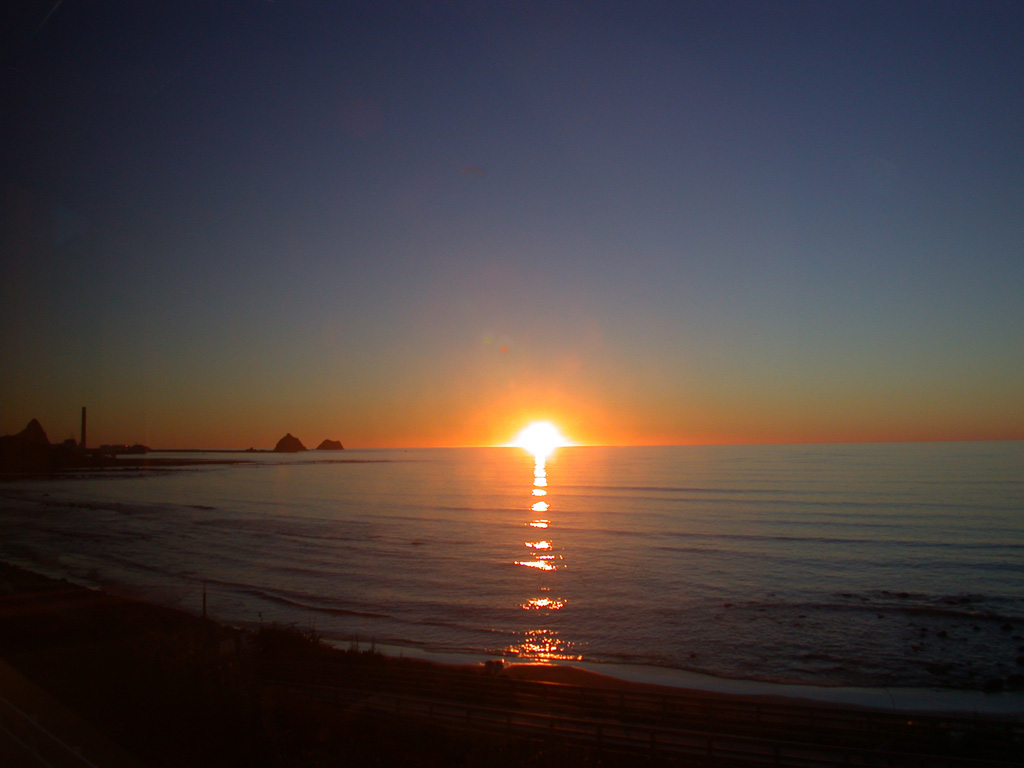
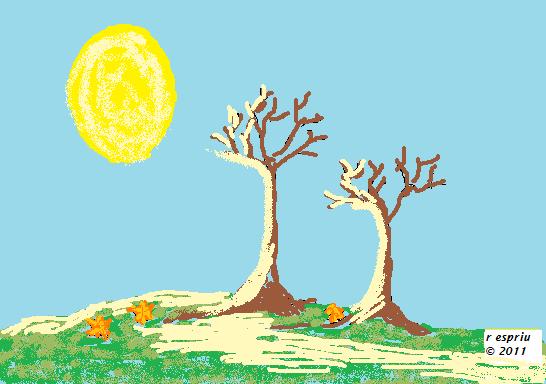
Filtered warmth reaches
out caressing window panes
roof tops in the dawn of
a chilling Fall morning

Yellow golden orb with
rays so real they feel as
a solid mass of butter a
tongue tasting delicious

Every surface a reflection
gleaming it’s majesty tinted
ecstasy held as in nature’s
mirror coveting it’s own

© November 2011 Renee Espriu

Music’s Memory

Musical notes wrap themselves
around her like charms on a
bracelet touching her skin
B Flats, C Sharps, staccato
dancing lightly tapping out
rhythms on her silvery hair

Ivory keys fill the spaces
between now and then when her
fingertips drew out singing
loft choirs yet teaching a
soloist the uniqueness in
using a voice as instrument

Images fleeting now seen but
dimly as through the clouded
lens of a camera losing it’s
battle to store more images in
memory’s photographic pages
holding lyrics of song books

Musical notes wrap themselves
around her like charms on a
bracelet touching her skin
B Flats, C Sharps, staccato
dancing lightly tapping out
rhythms on her silvery hair

© November 2011 Renee Espriu

Upon posting the quote from Helen Keller it gave me pause to remember a most loved pianist and organist whose love and passion for music helped me to understand that not all voices are the same and the uniqueness of some is a gift. Some of us, at times, do stand alone. This is dedicated to Dorothy, who after years of dedication to playing for church choirs and soloists lost her sight and could no longer play but only listen to the music she loved.

Quote by Helen Keller

Helen Keller is one of my favorite people that lived a full life no matter that it was a challenge. I admire her courage to find light in darkness and sound where there was none.

“The best and most beautiful things in the world
cannot be seen, nor touched…but are felt in the heart.”
-Helen Keller (1880-1968)

The Liebster Award


LIEBSTER AWARD

This is so special. Liebster is a German word meaning dearest, and the award is given to up-and-coming bloggers with less than 200 followers. Thank you Mohanna at http://insanebloom.wordpress.com for
nominating me for this award. As per stipulations, the five blogs I nominate are:

Bren         http://daydreamertoo.com
Pamela    http://wordsandthoughtspjs.wordpress.com
Marja       http://dutchcorner.blogspot.com
Gabrielle  http://gabriellebryden.wordpress.com
Tek’ia       http://tekia.wordpress.com

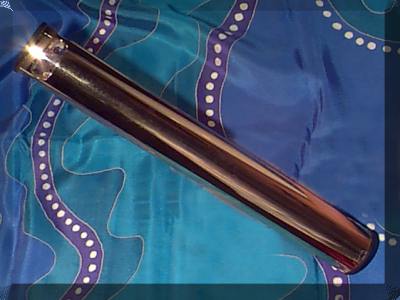
Shards of Rainbow Glass

Carefully placed
kaleidoscope
close to her eye
slowly turning
viewing colored,
broken shards
glass that forms
patterns
that she tries to
capture
each one a distant
meaning
in her memory

Beginning to turn
ever faster
cylinder
grasped gently
pieces of
rainbow colors
hinged
collide to try
connecting
bringing emotions
joyous sapphire
touching
crimson anger

The world fades
disconnected
pulling her along
whirlwind confusion
tied to wonderment
jagged edges
glass threatening
images retract
imploding
telescoping then
she’s gone
kaleidoscope
remaining

© November 2011 Renee Espriu

Thought I would give you some information on the history of the kaleidoscope, which I absolutely love and have a few of them, myself. Hope you enjoy!

Kaleidoscope

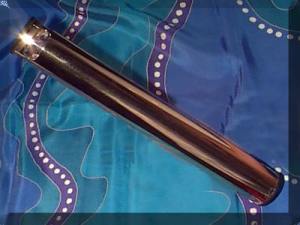
A kaleidoscope is a circle of mirrors containing loose, colored objects such as beads or pebbles and bits of glass. As the viewer looks into one end, light entering the other end creates a colorful pattern, due to the reflection off the mirrors. Coined in 1817 by Scottish inventor Sir David Brewster,[1] the word “kaleidoscope” is derived from the Ancient Greek καλ(ός) (beauty, beautiful), είδο(ς) (form, shape) and -σκόπιο (tool for examination)—hence “observer of beautiful forms.” [2]

Design

Kaleidoscopes operate on the principle of multiple reflection, where several mirrors are attached together. Typically there are three rectangular lengthwise mirrors. Setting the mirrors at a 45-degree angle creates eight duplicate images of the objects, six at 60°, and two at 90°. As the tube is rotated, the tumbling of the coloured objects presents the viewer with varying colours and patterns. Any arbitrary pattern of objects shows up as a beautiful symmetrical pattern created by the reflections in the mirrors. A two-mirror model yields a pattern or patterns isolated against a solid black background, while a three-mirror (closed triangle) model yields a pattern that fills the entire field.

For a 2D-symmetry group, a kaleidoscopic point is a point of intersection of two or more lines of reflection symmetry. In a discrete group, the angle between consecutive lines is 180°/n for an integer n≥2. At this point there are n lines of reflection symmetry, and the point is a center of n-fold rotational symmetry. See also symmetry combinations.

Modern kaleidoscopes are made with brass tubes, stained glass, wood, steel, gourds and almost any other material an artist can sculpt or manipulate. The part of the kaleidoscope containing objects to be viewed is the ‘object chamber’ or ‘object cell’. Object cells may contain almost any material. Sometimes the object cell is filled with liquid so the items float and move through the object cell with slight movement from the person viewing.

History

Patterns as seen through a kaleidoscope tube
Sir David Brewster began work leading towards invention of the kaleidoscope in 1815 when he was conducting experiments on light polarization[1] but it was not patented until two years later.[3] His initial design was a tube with pairs of mirrors at one end, pairs of translucent disks at the other, and beads between the two. Brewster chose renowned achromatic lens developer Philip Carpenter as the sole manufacturer of the kaleidoscope in 1817. It proved to be a massive success with two hundred thousand kaleidoscopes sold in London and Paris in just three months. Realising that the company could not meet this level of demand Brewster requested permission from Carpenter on 17 May 1818 for the device to be made by other manufacturers, to which he agreed.[4] Initially intended as a science tool, the kaleidoscope was later copied as a toy. Brewster later believed he would make money from this popular invention; however, a fault in his patent application allowed others to copy his invention.[1]

Cozy Baker (d. October 19, 2010)—founder of The Brewster Kaleidoscope Society—collected kaleidoscopes and wrote books about a few of the artists making them in the 1970s through 2000. Baker is credited with energizing a renaissance in kaleidoscope-making in America. In 1999 a short-lived magazine dedicated to kaleidoscopes—Kaleidoscope Review—was published, covering artists, collectors, dealers, events, and including how-to articles. This magazine was created and edited by Brett Bensley, at that time a well-known kaleidoscope artist and resource on kaleidoscope information.

Craft galleries often carry a few kaleidoscopes, while other enterprises specialize in them, carrying dozens of different types from different artists and craftspeople.

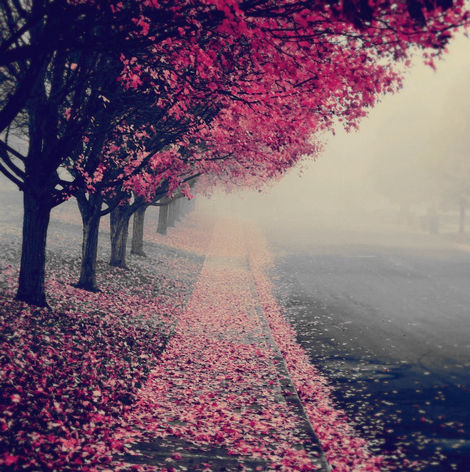
Confetti Butterflies

Fierce strong winds
unrelenting
as trees are rendered
powerless
leaves harnessed
as branches are picked
clean
thrown free a brilliant
confetti
displaying colors of
reds, yellows, golds
butterflies
strewn about along
streets and gutters as
carpets
clogging city drains
quieting footsteps
the warmth of nature
embroidered

© November 2011 Renee Espriu

Impressions

Walking along the sandy beaches
wind pushing against her like
swimming against the current
she is reminded of childhood
gone as though memories spent
when each day meant another

Sand making its’ way into her
shoes, into her clothes pulled
close around her as she hugs
herself closely, eyeing the
waves crash, incoming tides
leaving seaweed in her midst

Impressions of footprints she
leaves follow her briefly to
be washed away by salty brine
as the tears quickly mix with
ocean spray to erase all time
of a sun’s warming afterglow

The day sets quickly behind a
horizon displayed of reflected
colors on a watery ocean glass
rendering her figure merely a
dark silhouette lost to a past
as the sea reclaims the shore

© November 2011 Renee Espriu

Quote by Henry Wadsworth Longfellow

An idle mind does not grow and flourish, so to have it within our ability to indulge in those things such as reading, writing and everything connected to greater knowledge, and in that way create wonders….how that we not dare to try….How can we not!  Henry Longfellow says so much in just these two sentences. Inspiring!

“Sit in reverie and watch the changing color of the waves
that break upon the idle seashore of the mind.”
-Henry Wadsworth Longfellow (1807-1882)

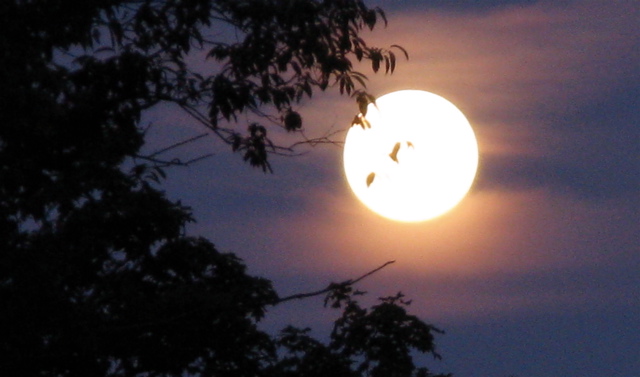
Night Shadows

A globe of light filling the
night sky casting night
shadows on fallow fields
silhouetted trees standing
silent only gently swaying
as a slight breeze passes
by beneath the Harvest moon

© November 2011 Renee Espriu

Life’s Syncopation

Syncopation like a child’s feet
keeping in time without
ever questioning to a
teacher’s beat

Like ants always marching
like tiny soldiers
roaming over hills and
stones and bolders

Like the tap, tap, tapping of
computer keyboards
within the cubicle walls
behind office doors

Like raindrops beating against
window panes in an
effort to gain entry
into your domain

Like the heart beating within
a lover’s chest to reveal
passion enclosed as a
birded nest

Like the pendulum swinging
while the pianist plays
ringing clear as church
bells on a rope sways

Like nature’s cycles bringing
gifts of seasons always
changing without reason it is
about Syncopation

© November 2011 Renee Espriu